
 EN

In chemical processing loops, mine ventilation shafts, and material conveyors, industrial drives rarely remain locked at 100% rated output across a production shift. When flow valves throttle or conveyor tonnage drops, legacy asynchronous motors suffer a steep efficiency cliff below 60% load, turning electrical input into wasted rotor heat and reactive current. Deploying an IE4/IE5 Efficiency Motor engineered around permanent magnet synchronous technology solves this partial-load bottleneck by maintaining flat efficiency curves across fluctuating speeds and torque demands.
Selecting a drive based solely on a full-load nameplate figure leaves facilities vulnerable to severe energy waste during turndown intervals. ENNENG addresses these challenges directly. As a specialized high-tech enterprise focused on the R&D, design, and manufacturing of high-efficiency permanent magnet synchronous motor systems, ENNENG provides a complete Energy Saving Motor Solution that eliminates standard rotor excitation losses. By matching an IE4/IE5 Efficiency Motor to real-world variable duty cycles, ENNENG helps industrial clients worldwide lower operational overhead.
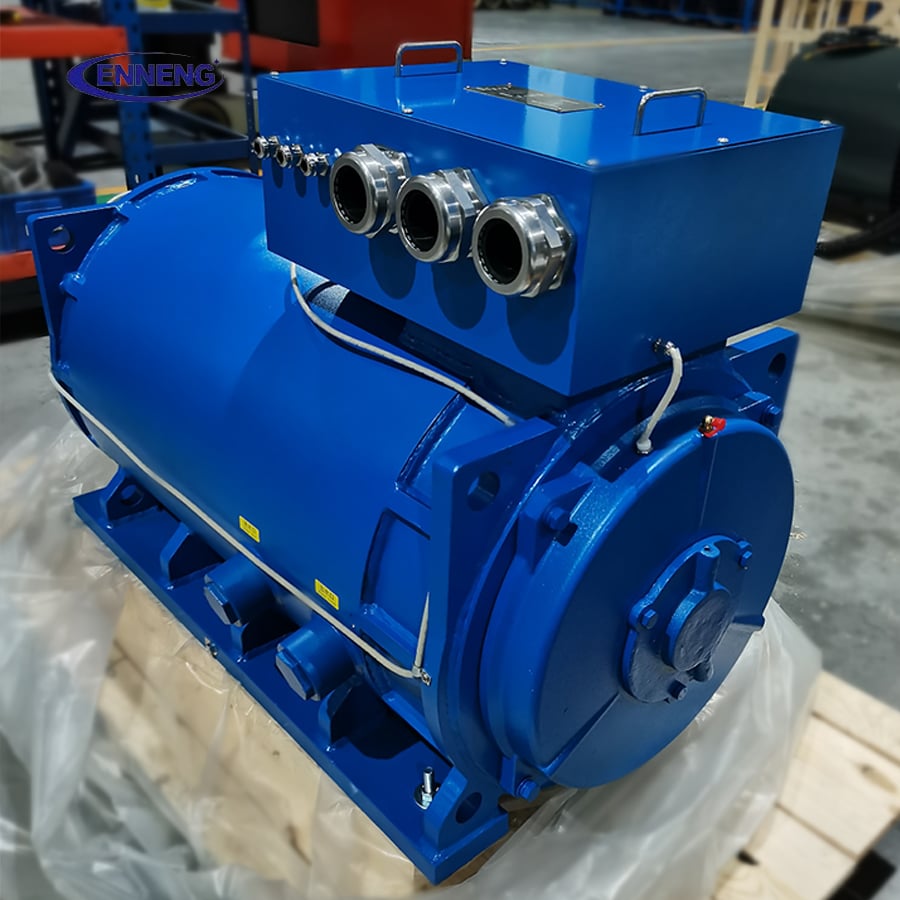
Technical Highlights: IE4/IE5 Efficiency Motor vs. Standard Induction Motor
Understanding how an IE4/IE5 Efficiency Motor preserves its performance advantage across changing industrial states requires separating line-operated metrics under IEC 60034-30-1 from converter-fed variable-speed operation under IEC TS 60034-30-2 and IEC 61800-9-2 power drive system standards.
The Mechanics of Synchronized Speed Under Variable Torque and Constant Torque
Variable-load industrial applications fall into two mechanical categories: variable-torque centrifugal fans and pumps where shaft power scales with the cube of speed, and constant-torque positive-displacement compressors, mixers, and conveyors where torque stays high even at low RPM. Unlike asynchronous induction motors that rely on load-dependent rotor slip to induce torque, an ENNENG IE4/IE5 Efficiency Motor locks rotor speed directly to the stator rotating magnetic field frequency. Zero-slip synchronization ensures exact speed control without slip losses as loads shift.
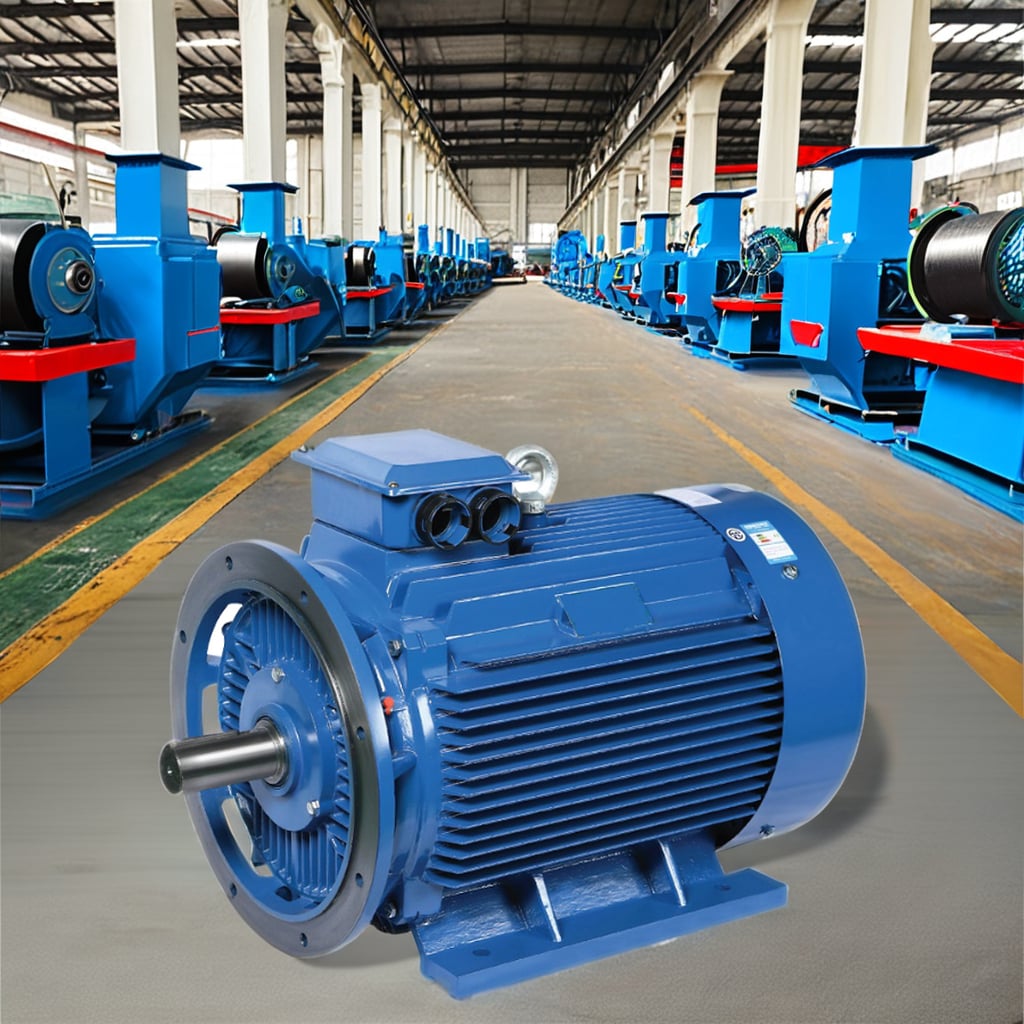
Eliminating Rotor Copper Losses Across Partial-Load Duty Cycles
In a conventional asynchronous motor, magnetizing current must be continuously induced into squirrel-cage rotor windings even when the machine operates at light load, creating continuous rotor copper loss and stray-load heat. In contrast, an ENNENG IE4/IE5 Efficiency Motor embeds high-performance NdFeB (Neodymium Iron Boron) permanent magnets directly into the rotor core. This pre-magnetized rotor establishes the air-gap magnetic field without grid excitation current, eliminating rotor copper losses across ENNENG permanent magnet solutions and preserving variable-load efficiency.
Core Advantages of an ENNENG IE4/IE5 Efficiency Motor in Variable States
Choosing an IE4/IE5 Efficiency Motor from ENNENG delivers clear technical advantages over legacy IE2 and IE3 induction drives in partial-load efficiency, power factor, and thermal reserve.
Superior Efficiency Across a 25% to 120% Operating Load Window
While standard induction motors lose efficiency rapidly below 70% load, an ENNENG IE4/IE5 Efficiency Motor sustains ultra-premium efficiency across a wide operating range of 25% to 120% of rated load. Rated efficiency runs 2% to 5% higher than asynchronous motors at full load and delivers 5% to 30% system electricity savings across low-voltage variable-load states.
Optimized Power Factor and Reduced Line Current Under Turn-Down
Asynchronous motors suffer severe power factor degradation when lightly loaded, often dropping below 0.60 and drawing excessive reactive current. An ENNENG synchronous drive maintains a power factor of 0.95 or higher, up to 1.0, across variable working states. This reduces stator operating current by more than 10%, cutting feeder cable losses, improving transformer utilization, and preventing NFPA 70 (NEC) overload trips.
Lower Temperature Rise and Compact Frame Footprint
Because rotor copper losses are zero, an ENNENG IE4/IE5 Efficiency Motor operates at a temperature rise 20K lower (staying under 60K) than induction units under IEEE 841 and NEMA MG 1 thermal frameworks. This cooler operating profile allows ENNENG to build motors one or two frame sizes smaller than equivalent asynchronous motors, saving space while preserving insulation life during low-speed constant-torque duty.
System-Level Integration Architecture: Maximizing Variable-Load Reliability
Capturing the full lifecycle value of an IE4/IE5 Efficiency Motor requires coordinating motor sizing, variable frequency drive (VFD) parameterization, and mechanical transmission efficiency.
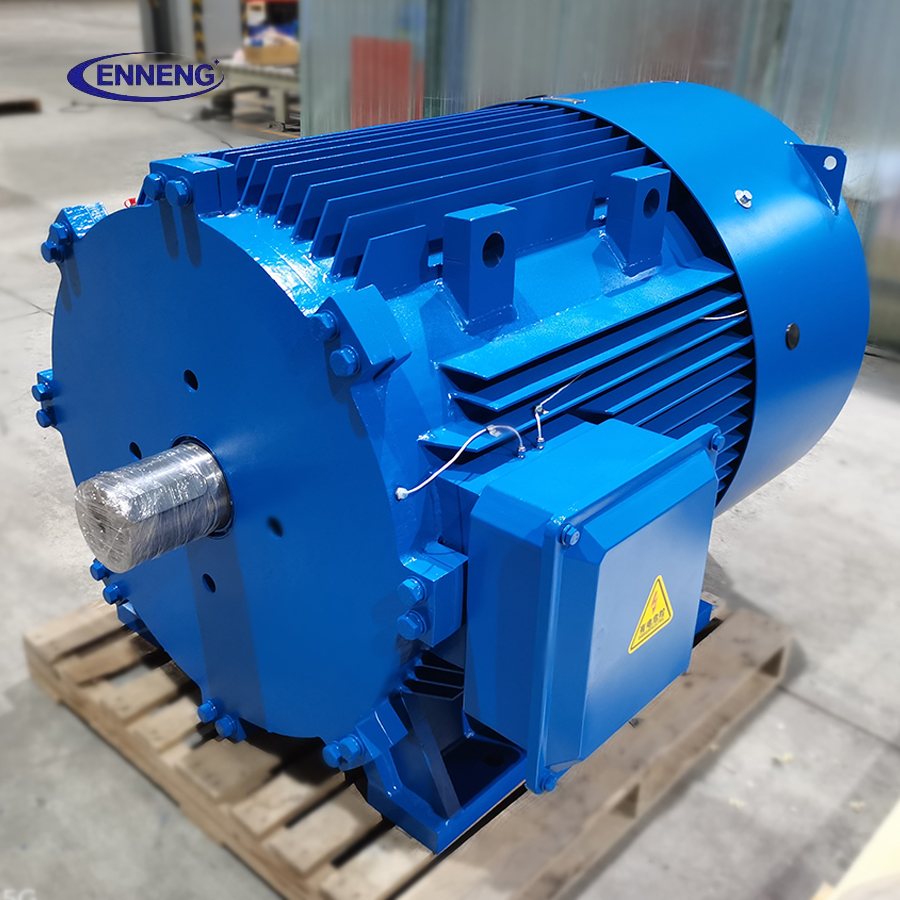
Matching Motor-Drive Control and Eliminating Mechanical Throttling
An oversized motor forced to run against throttled pump valves, closed fan dampers, or high-friction reduction gearboxes wastes the electromagnetic gain of an ultra-premium drive. By pairing a properly sized IE4/IE5 Efficiency Motor with a matched VFD and utilizing high-pole direct-drive configurations, ENNENG eliminates reducers and throttling losses, delivering a verifiable Energy Saving Motor Solution.
Field Commissioning Checklist for Variable-Load Applications
Deploying an IE4/IE5 Efficiency Motor in fluctuating industrial processes requires disciplined engineering verification:
- Classify Load Torque and Map the Duty Histogram: Log shift hours across speed and torque bands to confirm the synchronous motor operates within its 25% to 120% window rather than sizing solely for rare peak events.
- Low Noise and VFD Parameter Matching: Operating smoothly with zero slip and no gear mesh keeps vibration within ISO 10816 limits and decibel levels below 55 dB; verify VFD carrier frequencies, cooling speeds, and cable shielding before startup.
- Baseline Metering and Lockout Safety: Record pre-retrofit and post-retrofit kW, flow, and temperature baselines across equivalent production states, and enforce OSHA 1910.147 lockout/tagout protocols via ENNENG technical support during inspections.
Application Case Studies and the ENNENG Customization Advantage
ENNENG capabilities are proven across variable-load industries, spanning unified generator and motor power ratings from 5kW to 5MW (110V to 690V) alongside 1kW to 10kW vertical axis wind turbines (3kW, 5kW, and 10kW focus) for hybrid microgrids.
- Rubber Tire Machinery Industry: Tire mixing lines experience steep torque fluctuations across batch cycles and previously suffered from heavy gearbox maintenance and induction slip losses. Integrating ENNENG low-speed direct-drive permanent magnet systems provided a maintenance-free Energy Saving Motor Solution that achieved verified electricity savings of 7% to 40%.
- Industrial Air Compressor Systems: Plant air compressors cycle frequently between loaded and unloaded states, wasting power with fixed-speed induction drives. Pairing an ENNENG IE4/IE5 Efficiency Motor with customized VFD speed control kept temperature rise under 60K and achieved electricity savings of up to 50%.
The ENNENG Customization Advantage
No two facilities share identical load profiles. ENNENG delivers custom permanent magnet solutions across 5kW to 5MW ratings and 110V to 690V voltages for water treatment, oilfields, and mining environments. Contact ENNENG Today:
- WhatsApp: +86 18562780228
- E-Mail: [email protected]
- Phone: +86 532 66000559
FAQ
Q: Why does an ENNENG IE4/IE5 Efficiency Motor outperform IE3 induction motors at partial loads?
A: Standard IE3 induction motors must continuously induce current into rotor bars to maintain a magnetic field, causing rotor copper losses and low power factor when load drops below 60%. An ENNENG IE4/IE5 Efficiency Motor uses rotor-embedded NdFeB permanent magnets to eliminate excitation losses, sustaining high efficiency across 25% to 120% load.
Q: Can an IE4/IE5 Efficiency Motor serve as a drop-in Energy Saving Motor Solution for existing equipment?
A: Yes, an ENNENG IE4/IE5 Efficiency Motor is available in universal IEC and NEMA frame dimensions for direct replacement of asynchronous motors, as well as compact custom frames spanning 5kW to 5MW and 110V to 690V. Pairing the motor with a matched VFD ensures optimal variable-load efficiency and soft-start protection.